LLDPE Prices Dropped 12% in June — Why Your Stretch Film Costs Won’t Follow Right Away
If you’ve been watching raw material prices lately, you’ve probably noticed the steep drop in LLDPE (linear low-density polyethylene) over the past month. From early June to late June, spot prices fell roughly 12% in the China market — a pretty significant swing in just 30 days.
A lot of buyers see that number and immediately ask: “When will stretch film prices come down too?”
Fair question. But the answer isn’t as simple as “next week.” There’s a time lag between raw material price movements and finished product pricing — and understanding that lag can save you a lot of money and frustration in a volatile market.
What Happened to LLDPE in June?
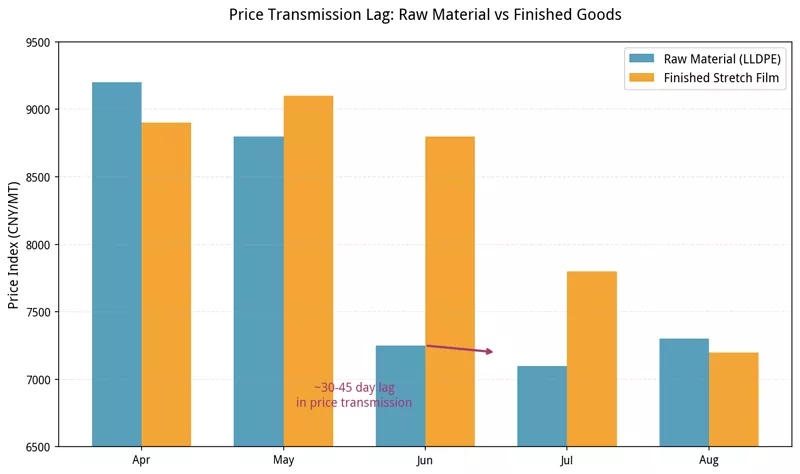
First, let’s recap the numbers. LLDPE started June around ¥8,276 per metric ton and ended the month around ¥7,250 — that’s a drop of over ¥1,000 per ton in just four weeks.
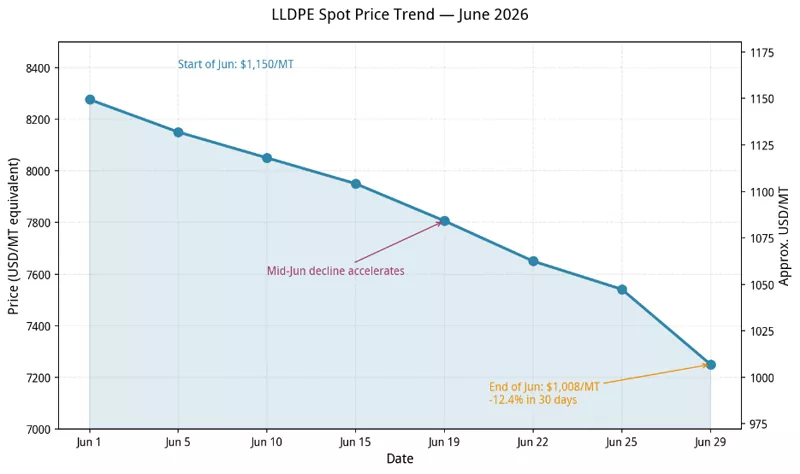
The decline happened in two phases:
First half of June: Narrow range trading, prices drifted down slowly as demand softened going into the summer slow season
Second half of June: Steeper drop, driven by easing geopolitical tensions in the Middle East (which pulled crude oil prices down), new production capacity coming online, and downstream factories cutting back on orders
Looking ahead, most industry analysts expect LLDPE prices to stay under pressure through Q3, with more new PE capacity set to start up in the second half of 2026. Supply is growing faster than demand right now, which usually keeps a lid on prices.
The Price Transmission Lag: Why Raw Material Drops Don’t Show Up in Your Invoice Next Week
Here’s the part a lot of buyers don’t fully get — there’s always a delay between raw material price changes and finished stretch film pricing. Usually 30 to 45 days, sometimes longer.
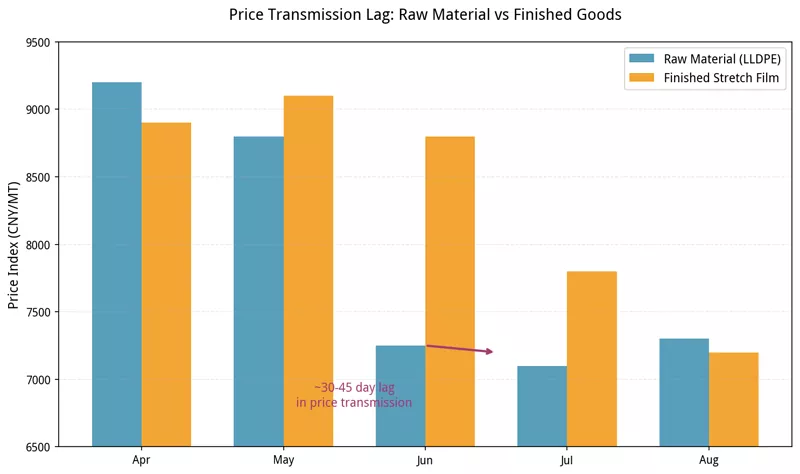
Why the gap? A few reasons:
1. Inventory in the pipeline
Film manufacturers don’t buy raw material the day before they run a production batch. They buy in bulk, store it, and work through inventory over weeks. If a factory bought LLDPE at ¥8,500/ton in late May, that material is still being turned into stretch film through June and into July. They can’t just drop prices overnight when the spot market moves — they paid more for the material already sitting in their warehouse.
2. Production scheduling and order backlogs
Most stretch film factories run production on a schedule, with orders queued up 2-4 weeks out. The film being produced today was probably quoted and ordered 2-3 weeks ago, when raw material prices were higher. Those orders get produced at the agreed price, regardless of what the spot market does in the meantime.
3. Fixed costs don’t disappear
Raw material is the biggest cost factor, but it’s not the only one. Labor, energy, equipment maintenance, packaging, logistics — these costs don’t move up and down with LLDPE prices. So even when resin drops 12%, finished film prices never drop by the same percentage.
The same lag works in reverse, by the way. When raw material prices spike upward, film factories can absorb some of it for a while using cheaper inventory. But eventually the higher costs hit, and prices go up — often faster on the way up than on the way down.
Why Locking Pricing Matters More in Volatile Markets
In a market that moves 10-15% in a single month, price uncertainty becomes a real business risk. You quote a customer a pallet wrap price today, and three weeks later when you place the order, your costs could have shifted by thousands of dollars.
Locked pricing — where you agree on a fixed price for a set volume over a set period (usually 1-3 months) — takes that uncertainty off the table.
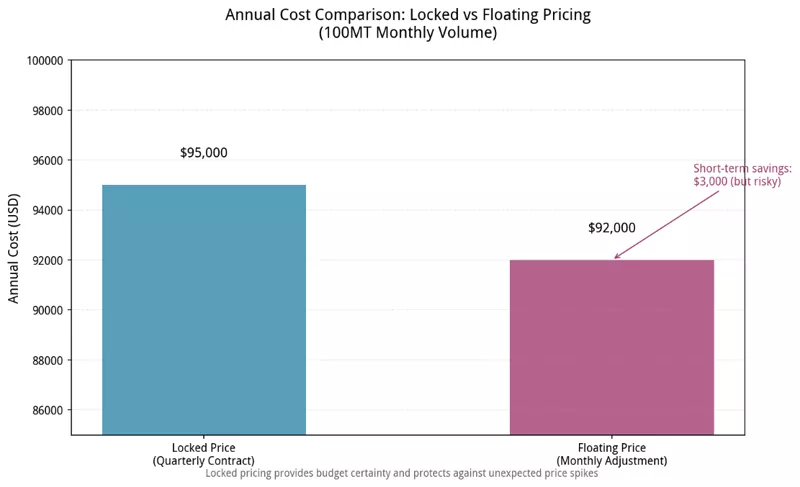
Here’s what you get with locked pricing:
Budget certainty
You know exactly what your stretch film costs will be for the next quarter. No surprises, no last-minute price hikes eating into your margins. You can quote your own customers with confidence, knowing your costs won’t jump around underneath you.
Protection against sudden spikes
Right now prices are going down, which feels great. But markets can turn fast — a supply disruption, a geopolitical event, a crude oil spike, and LLDPE could jump 10% in a week. If you’re on floating pricing, you feel that jump immediately. If you’re locked in, you don’t.
Stable supply relationships
When you commit to a volume and lock a price, your supplier can plan production better, secure raw material at the right time, and make sure you get your orders on schedule. It’s a two-way street — you get price stability, they get volume certainty.
Now, is locking always the right move? Not necessarily. If you’re confident prices will keep dropping for a while, floating might save you money in the short term. But here’s the catch — most people aren’t good at timing the market. By the time you’re sure prices have bottomed out, they’ve usually already started going back up.
What This Means for Your Stretch Film Sourcing
If you’re buying stretch film regularly — whether it’s hand wrap, machine wrap, or specialty films — here’s our take:
1.Don’t expect finished film prices to drop 12% just because LLDPE did. The lag means you’ll see gradual adjustments over 1-2 months, not an overnight price cut.
2.If you have steady volume, consider locking pricing for Q3. Prices are at a relatively low point right now compared to earlier this year. Locking in at current levels gives you budget certainty for the next quarter, with protection if prices bounce back.
3.Talk to your supplier about their raw material inventory position. Knowing where they stand on material costs will give you a better sense of when price adjustments might happen.
At Yuhong Plastic, we work with clients on both floating and locked pricing models, depending on what makes sense for their business. We’re transparent about our raw material costs and lead times, so you always know where your pricing comes from.
If you want to discuss locking in stretch film pricing for the next quarter, or just want a better sense of where the market is heading, reach out anytime. We’re happy to walk through the numbers and figure out what works best for your operation.
Related News
Leave me a message