The hook (use the May 2026 Brent move as the "now" anchor)
On May 11, 2026, Brent closed at $98.12/bbl — up ~2% week-on-week, and the highest print since the Iran-related spikes of late 2025. Within days, Maersk, CMA CGM and Hapag-Lloyd confirmed BAF (Bunker Adjustment Factor) hikes of 5–8% on Asia–Europe and Trans-Pacific lanes, effective May 1.
If you're an exporter or procurement lead, this sequence probably feels familiar — but the timing rarely matches your intuition. A lot of buyers assume: "Oil spiked Tuesday, so my freight quote next Monday should be up."In reality, the pass-through takes 30–60 days from crude to bunker to your TEU line item, and carriers typically revise BAF on a semi-monthly or monthly cycle, not weekly.
That lag is where margins leak — or where smart buyers quietly lock in.
How the chain actually works (3 hops, not 1)
Most people collapse "oil up → freight up" into one step. It's really three:
Hop 1 — Crude → Bunker fuel
Container ships burn VLSFO/HFO, priced off benchmarks like Platts Singapore (MOPS) or Rotterdam. Bunker typically represents 40–60% of total ocean freight cost. When Brent moves, bunker follows with a lag because physical bunker contracts and port bunkered stock don't reset daily.
Hop 2 — Bunker → BAF/EBS
Carriers publish BAF formulas in their tariffs (example: Maersk Europe lane BAF = (MOPS 380CST − base $450/MT) × 1.2 × TEU factor). Revisions come semi-monthly or monthly, not spot. That's why you saw the May 1 BAF hike after April's crude run-up was already old news.
Hop 3 — Base freight + BAF → SCFI / your quote
Spot rates (SCFI) react faster to demand/supply shocks (Red Sea, Panama draft, peak season GRI), but the fuel component inside your quote still trails crude by roughly one carrier billing cycle.
💡 Rule of thumb from forwarder desks: an 80% Brent move typically pushes Asia–USWC spot rates up 15–30% over the following 60–90 days, assuming liners don't pre-adjust capacity.
Why "semi-monthly" creates a false sense of speed
Carriers love to say "we adjust BAF frequently" — and technically, 5–8% every few weeks is frequent compared to the old quarterly model. But for a buyer trying to time a shipment, semi-monthly is still slow relative to crude volatility.
Look at the recent sequence:
Source: carrier BAF bulletins + ZSIron coverage.
So if you wait for "the freight quote to confirm the oil move," you're already one cycle behind.
What this means for your production timeline
Here's the part most logistics articles skip — and the part that actually costs you money.
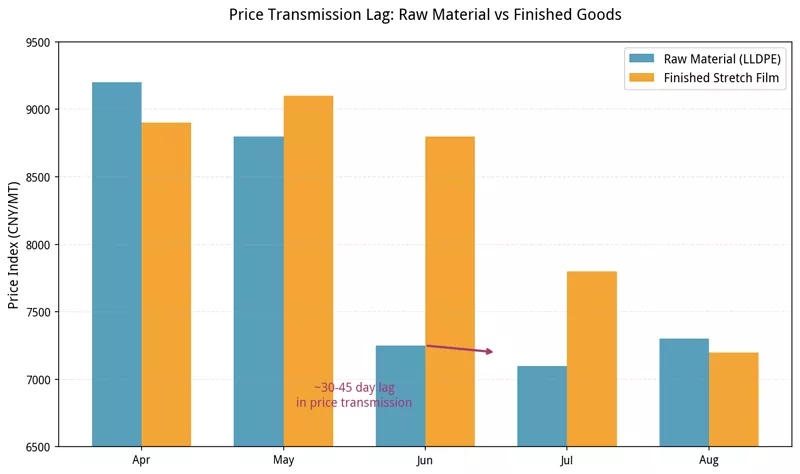
Crude doesn't just move freight. It also moves your resin. For a stretch film / PP/PE buyer (hi, that's us at Yuhong too), petrochemical pass-through to resin lags Brent by ~60–90 days. Which means:
Brent dips in early June → bunker eases mid-July → your July BAF quote looks better.
But your resin PO for July production was already priced off April/May Brent — so the film/tape/carton cost hasn't dipped yet.
If you only look at ocean freight to time your PO, you'll miss the wider window.
Practical rhythm we suggest to our own buyers:
Spot a Brent move you like? Don't wait for SCFI to confirm it.
Pull production forward 4–6 weeks if your contract allows — resin and film respond on the 60–90 day clock, not the 30-day BAF clock.
Lock ocean contracts before the lag catches up. If you signed annual in Oct 2025 when Brent was ~$64, you're protected through Q3 2026. If you're on spot, your Q3 renewal is where the exposure sits.
Three charts worth putting on your wall (and in this blog)
Brent Crude (12-month rolling) — annotate Mar 2026 spike (~$118), May 2026 $98 print. Source: Trading Economics / EIA.
BAF / Singapore 380CST bunker price, same window — shows the 30–45 d lag visually. Source: Platts MOPS.
SCFI Asia–USWC + Asia–North Europe, same window — overlay Brent to show correlation but offset the freight curve by ~6 weeks. Source: Shanghai Shipping Exchange.
(Ask your logistics guy or freight forwarder to pull these — 10 minutes in Excel, high payoff for internal briefings.)
Bottom line for export buyers
Ocean freight "re-prices" fuel semi-monthly, not in real time.
Crude → freight transmission lag is ~30–60 days for the bunker component, 60–90 days for the full spot rate move.
If you see a crude-friendly window, don't wait for the freight quote to validate it — give your factory a 4–6 week heads-up to push production forward, especially for resin-heavy products (stretch film, tape, PP woven, strapping, etc.).
On the contract side: if you're still on spot or quarterly ocean rates in Q3 2026, the May BAF hike is already baked into your renewal. Next contract cycle, ask for a BAF cap or index clause — 3PL consolidators and high-volume shippers routinely negotiate these in 2026.
A note from Yuhong Plastic
We live on both sides of this — we buy LLDPE/MLLDPE (resin lags Brent ~60–90 d), and we ship handle stretch wrap, machine pre-stretched film, compostable pallet wrap to 15+ countries. When crude swung in Mar 2026, our production team pulled April–May POs forward by 5 weeks; our logistics team locked Q2 ocean contracts in Feb before the May BAF print. It's not glamorous, but it's why our FOB quotes to regular buyers stayed flat while spot market freight jumped 15–30%.
If you're planning Q3–Q4 shipment volumes and want to sanity-check your production vs freight timing, ping us — we've got the spreadsheets open.
Date
Brent
BAF action
Lag
Mar 2026
~$118 (conflict peak)
EBS + emergency surcharges layered on
—
Apr 2026
Cooling to ~$85–90
BAF still elevated (Mar bunker stock cost rolling through)
We use cookies to offer you a better browsing experience, analyze site traffic and personalize content. By using this site, you agree to our use of cookies.Privacy Policy